


 021-51111890
 购物车()
购物车()
 sales@molnova.cn







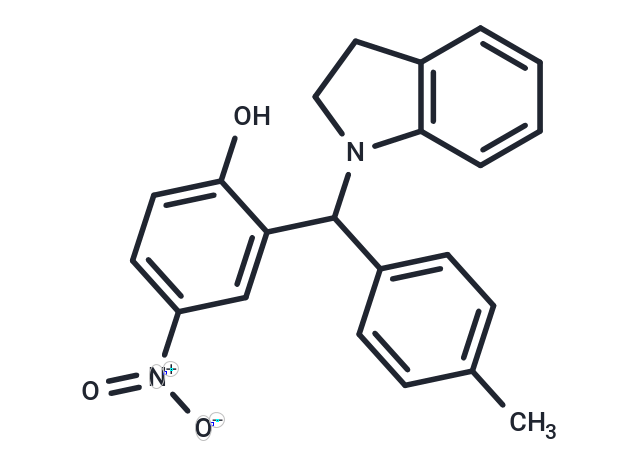
HNPMI
CAS No. 1980848-48-3
HNPMI ( —— )
产品货号. M37340 CAS No. 1980848-48-3
HNPMI 是 EGFR 抑制剂,对肿瘤细胞有细胞毒性作用。HNPMI 可以下调骨桥蛋白、生存素和组织蛋白酶 S 的蛋白水平,从而导致细胞凋亡 (apoptosis)。HNPMI 还可以通过调节 CRC 细胞系中的 BCL-2/BAX 和 p53 来抑制肿瘤发生。
纯度: >98% (HPLC)
 COA
Datasheet
HNMR
HPLC
MSDS
Handing Instructions
COA
Datasheet
HNMR
HPLC
MSDS
Handing Instructions
| 规格 | 价格/人民币 | 库存 | 数量 |
| 5MG | ¥550 | 有现货 |


|
| 10MG | ¥905 | 有现货 |
|
| 25MG | ¥1748 | 有现货 |
|
| 50MG | ¥2762 | 有现货 |
|
| 100MG | ¥4401 | 有现货 |
|
| 500MG | ¥8883 | 有现货 |
|
| 1G | 获取报价 | 有现货 |
|
生物学信息
-
产品名称HNPMI
-
注意事项本公司产品仅用于科研实验,不得用于人体或动物的临床与诊断
-
产品简述HNPMI 是 EGFR 抑制剂,对肿瘤细胞有细胞毒性作用。HNPMI 可以下调骨桥蛋白、生存素和组织蛋白酶 S 的蛋白水平,从而导致细胞凋亡 (apoptosis)。HNPMI 还可以通过调节 CRC 细胞系中的 BCL-2/BAX 和 p53 来抑制肿瘤发生。
-
产品描述HNPMI is an inhibitor of EGFR and has cytotoxic effects on tumor cells. HNPMI can downregulate the protein levels of osteopontin, survivin and cathepsin S, leading to apoptosis. HNPMI also regulates BCL-2/BAX and p53 in CRC cell lines to inhibit tumorigenesis.
-
体外实验——
-
体内实验——
-
同义词——
-
通路Apoptosis
-
靶点Apoptosis
-
受体Apoptosis | EGFR
-
研究领域——
-
适应症——
化学信息
-
CAS Number1980848-48-3
-
分子量360.41
-
分子式C22H20N2O3
-
纯度>98% (HPLC)
-
溶解度——
-
SMILESO=[N+]([O-])C1=CC=C(C(C(N2C3=C(CC2)C=CC=C3)C4=CC=C(C)C=C4)=C1)O
-
化学全称——
运输与储存
-
储存条件(-20℃)
-
运输条件With Ice Pack
-
稳定性≥ 2 years
参考文献
1. Kandhavelu J, et al. A novel EGFR inhibitor, HNPMI, regulates apoptosis and oncogenesis by modulating BCL-2/BAX and p53 in colon cancer. Br J Pharmacol. 2024 Jan;181(1):107-124.?
产品手册




关联产品
-
Britannin
Britannin 是一种倍半萜内酯,可通过人乳腺癌细胞的线粒体信号通路抑制增殖并诱导细胞凋亡。
-
Sophoraflavanone G
Sophoraflavanone G (Kushenol F) 是从苦参中分离出来的,通过抑制 MAPK 相关途径诱导 MDA-MB-231 和 HL-60 细胞凋亡。
-
PRDX1-IN-1
PRDX1-IN-1 is a selective inhibtor of PRDX1 with an IC50 value of 0.164 μM. PRDX1-IN-1 can be used in researches related to cancer.PRDX1-IN-1 promots intracellular ROS accumulation, and inhibits the proliferation, invasion and migration of cancer cells besides inducing apoptosis. PRDX1-IN-1 could be used in cancer research.


