


 021-51111890
 购物车()
购物车()
 sales@molnova.cn







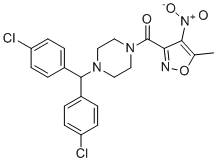
ML-210
CAS No. 1360705-96-9
ML-210 ( ML 210 | ML210 )
产品货号. M11484 CAS No. 1360705-96-9
一种小分子探针,可选择性杀死诱导表达突变 RAS 的细胞;抑制 BJeLR(表达 HRAS G12V)细胞系,IC50 为 25 nM。
纯度: >98% (HPLC)
 COA
Datasheet
HNMR
HPLC
MSDS
Handing Instructions
COA
Datasheet
HNMR
HPLC
MSDS
Handing Instructions
| 规格 | 价格/人民币 | 库存 | 数量 |
| 2MG | ¥442 | 有现货 |


|
| 5MG | ¥708 | 有现货 |
|
| 10MG | ¥1264 | 有现货 |
|
| 25MG | ¥2158 | 有现货 |
|
| 50MG | ¥3711 | 有现货 |
|
| 100MG | ¥4698 | 有现货 |
|
| 200MG | ¥6921 | 有现货 |
|
| 500MG | ¥10170 | 有现货 |
|
| 1G | 获取报价 | 有现货 |
|
| 1 mL x 10 mM in DMSO | ¥739 | 有现货 |
|
生物学信息
-
产品名称ML-210
-
注意事项本公司产品仅用于科研实验,不得用于人体或动物的临床与诊断
-
产品简述一种小分子探针,可选择性杀死诱导表达突变 RAS 的细胞;抑制 BJeLR(表达 HRAS G12V)细胞系,IC50 为 25 nM。
-
产品描述A small-molecule probe that selectively kills cells induced to express mutant RAS; inhibits BJeLR (expressing HRAS G12V) cell lines with IC50 of 25 nM, displays 23-fold sensitivity over BJeH-LT (isogenic to BJeLR without HRAS G12V) cell lines; a useful tool for identifying oncogene-specific pathways and targets in cancer cells.
-
体外实验——
-
体内实验——
-
同义词ML 210 | ML210
-
通路MAPK/ERK Signaling
-
靶点Ras
-
受体Ras
-
研究领域——
-
适应症——
化学信息
-
CAS Number1360705-96-9
-
分子量475.32
-
分子式C22H20Cl2N4O4
-
纯度>98% (HPLC)
-
溶解度In Vitro:?DMSO : 25 mg/mL (52.60 mM)
-
SMILESO=C(N1CCN(C(C2=CC=C(Cl)C=C2)C3=CC=C(Cl)C=C3)CC1)C4=NOC(C)=C4[N+]([O-])=O
-
化学全称(4-(bis(4-chlorophenyl)methyl)piperazin-1-yl)(5-methyl-4-nitroisoxazol-3-yl)methanone
运输与储存
-
储存条件(-20℃)
-
运输条件With Ice Pack
-
稳定性≥ 2 years
参考文献
1. We?wer M, et al. Bioorg Med Chem Lett. 2012 Feb 15;22(4):1822-6.
产品手册




关联产品
-
ARS-1323-alkyne
ARS-1323-alkyne 是一种 switch-II pocket (S-IIP) 抑制剂,也是活细胞中 KRASG12C 核苷酸状态的构象特异性化学报告基因。
-
K-Ras G12C-IN-1
突变型 K-ras G12C 的新型不可逆抑制剂。
-
KBFM123
KBFM123 (KBFM-123) 是 GTP 结合形式的 H-Ras 的小分子变构抑制剂。


