


 021-51111890
 购物车()
购物车()
 sales@molnova.cn






 首页-
Products -
Proteasome/Ubiquitin -
Endogenous Metabolite -
D-Ribose 5-phosphate disodium dihydrate
首页-
Products -
Proteasome/Ubiquitin -
Endogenous Metabolite -
D-Ribose 5-phosphate disodium dihydrate
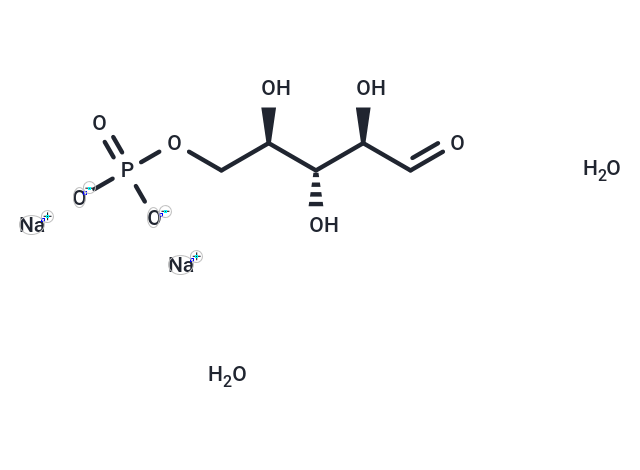
D-Ribose 5-phosphate disodium dihydrate
CAS No. 207671-46-3
D-Ribose 5-phosphate disodium dihydrate ( —— )
产品货号. M36842 CAS No. 207671-46-3
D-Ribose 5-phosphate disodium dihydrate 是戊糖磷酸途径 (PPP) 氧化分支的中间产物,是 PPP 非氧化分支的最终产物。D-Ribose 5-phosphate 用于核苷酸和核酸的合成。
纯度: >98% (HPLC)
 COA
Datasheet
HNMR
HPLC
MSDS
Handing Instructions
COA
Datasheet
HNMR
HPLC
MSDS
Handing Instructions
| 规格 | 价格/人民币 | 库存 | 数量 |
| 500MG | 获取报价 | 有现货 |


|
| 1G | 获取报价 | 有现货 |
|
生物学信息
-
产品名称D-Ribose 5-phosphate disodium dihydrate
-
注意事项本公司产品仅用于科研实验,不得用于人体或动物的临床与诊断
-
产品简述D-Ribose 5-phosphate disodium dihydrate 是戊糖磷酸途径 (PPP) 氧化分支的中间产物,是 PPP 非氧化分支的最终产物。D-Ribose 5-phosphate 用于核苷酸和核酸的合成。
-
产品描述D-Ribose 5-phosphate disodium dihydrate is an intermediate of the oxidative branch of the pentose phosphate pathway (PPP) and an end product of the nonoxidative branch of the PPP. D-Ribose 5-phosphate is used in the synthesis of nucleotides and nucleic acids.
-
体外实验Ribose-5-phosphate is generally assumed to arise via the oxidative and nonoxidative pentose phosphate pathways.
-
体内实验——
-
同义词——
-
通路Proteasome/Ubiquitin
-
靶点Endogenous Metabolite
-
受体Endogenous Metabolite
-
研究领域——
-
适应症——
化学信息
-
CAS Number207671-46-3
-
分子量310.1
-
分子式C5H13Na2O10P
-
纯度>98% (HPLC)
-
溶解度In Vitro:?H2O 中的溶解度 : 100 mg/mL (322.48 mM; 超声助溶)DMSO 中的溶解度 : 1 mg/mL (3.22 mM; 超声助溶 )
-
SMILESO=P([O-])([O-])OC[C@@H](O)[C@@H](O)[C@@H](O)C=O.[Na+].O.[Na+].O
-
化学全称——
运输与储存
-
储存条件(-20℃)
-
运输条件With Ice Pack
-
稳定性≥ 2 years
参考文献
1. Grochowski LL, et al. Ribose-5-phosphate biosynthesis in Methanocaldococcus jannaschii occurs in the absence of a pentose-phosphate pathway. J Bacteriol. 2005 Nov;187(21):7382-9.?
产品手册



关联产品
-
2-Acetyl-3-ethylpyra...
2-Acetyl-3-ethylpyrazine 是一种内源性代谢产物。
-
Lactoferrin
乳铁蛋白由哺乳动物分泌,具有广泛的生物效应,包括增强应用良好的益生菌菌株的耐冷性。
-
Propionic acid
丙酸(PA)广泛用作食品中的抗真菌剂。它天然存在于乳制品中,含量较低,并与其他短链脂肪酸 (SCFA) 一起普遍存在于人类和其他哺乳动物的胃肠道中,作为微生物消化碳水化合物的最终产物。


