


 021-51111890
 购物车()
 sales@molnova.cn







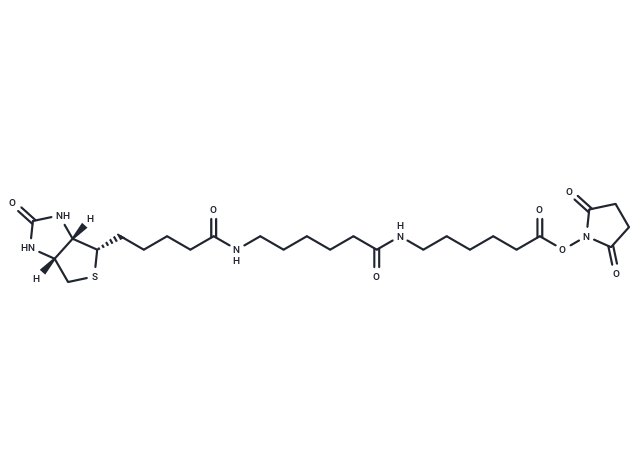
Biotin-LC-LC-NHS
CAS No. 89889-52-1
Biotin-LC-LC-NHS ( —— )
产品货号. M35244 CAS No. 89889-52-1
Biotin-LC-LC-NHS 是 SMCC 交联剂,可用于标记抗体和小分子活性分子,比如紫杉醇。
纯度: >98% (HPLC)
 COA
Datasheet
HNMR
HPLC
MSDS
Handing Instructions
| 规格 | 价格/人民币 | 库存 | 数量 |
| 5MG | ¥283 | 有现货 |


|
| 10MG | ¥407 | 有现货 |
|
| 25MG | ¥641 | 有现货 |
|
| 50MG | ¥1079 | 有现货 |
|
| 100MG | ¥1692 | 有现货 |
|
| 200MG | ¥2547 | 有现货 |
|
| 500MG | 获取报价 | 有现货 |
|
| 1G | 获取报价 | 有现货 |
|
生物学信息
-
产品名称Biotin-LC-LC-NHS
-
注意事项本公司产品仅用于科研实验,不得用于人体或动物的临床与诊断
-
产品简述Biotin-LC-LC-NHS 是 SMCC 交联剂,可用于标记抗体和小分子活性分子,比如紫杉醇。
-
产品描述Biotin-LC-LC-NHS is a SMCC cross-linking reagent that can be used to mark antibody and other small molecules, such as Paclitaxel.
-
体外实验Biotinylation of antibodies is accomplished by the reaction of Biotin-LC-LC-NHS (1 mg/mL in dimethyl formamide) with the protein in aqueous phase pH 7.4. The molar ratio of biotin to antibody in the labeling reaction was 10:1 (the final concentration of biotin was 70 μM) .
-
体内实验——
-
同义词——
-
通路Others
-
靶点Other Targets
-
受体Others
-
研究领域——
-
适应症——
化学信息
-
CAS Number89889-52-1
-
分子量567.7
-
分子式C26H41N5O7S
-
纯度>98% (HPLC)
-
溶解度In Vitro:?DMSO 中的溶解度 : 125 mg/mL (220.19 mM; 超声助溶 )
-
SMILESC(CCCC(NCCCCCC(NCCCCCC(ON1C(=O)CCC1=O)=O)=O)=O)[C@H]2[C@@]3([C@](CS2)(NC(=O)N3)[H])[H]
-
化学全称——
运输与储存
-
储存条件(-20℃)
-
运输条件With Ice Pack
-
稳定性≥ 2 years
参考文献
1. K Dill, et al. Immunoassays Based on Electrochemical Detection Using Microelectrode Arrays. Biosens Bioelectron. 2004 Nov 1;20(4):736-42.?
产品手册



关联产品
-
Lophanthoidin B
Lophanthoidin B 是从 Rabdosia lophanthoides 草药中分离出来的天然产物。
-
Thymosin β4 (16-38)
Thymosin β4 (16-38)
-
P110
Dynamin-related protein 1 (Drp1) inhibitor, inhibits Drp1 GTPase activity. Displays no effect on dynamin 1 or other mitochondrial dynamics-related proteins. Inhibits mitochondrial fission, dysfunction and reactive oxygen species (ROS) production in vitro. Reduces programmed cell death and improves cell viability by protecting mitochondrial integrity. Reduces mitochondrial fragmentation and mitochondrial ROS production in mouse model of Parkinson's disease. Cell permeable.


