


 021-51111890
 购物车()
购物车()
 sales@molnova.cn







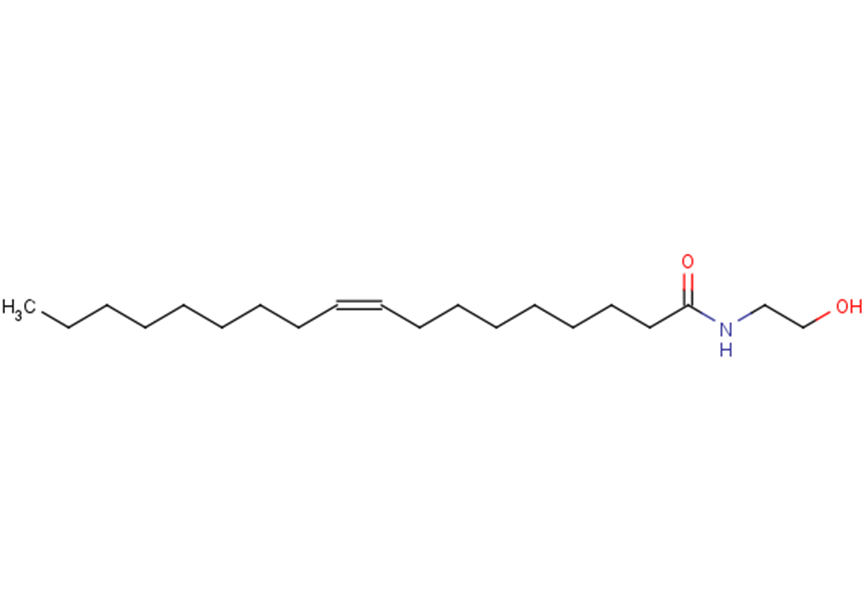
Oleoylethanolamide
CAS No. 111-58-0
Oleoylethanolamide ( N-Oleoylethanolamide,Oleamide MEA,Oleic acid monoethanolamide )
产品货号. M22670 CAS No. 111-58-0
油酰乙醇酰胺是 PPAR-α 的高亲和力内源性激动剂。体外研究表明,OEA 通过抑制 Smad2/3 磷酸化、α-SMA 表达和肌成纤维细胞转化来抑制转化生长因子 β1 刺激的 HSC 活化。
纯度: >98% (HPLC)
 COA
Datasheet
HNMR
HPLC
MSDS
Handing Instructions
COA
Datasheet
HNMR
HPLC
MSDS
Handing Instructions
| 规格 | 价格/人民币 | 库存 | 数量 |
| 2MG | ¥395 | 有现货 |


|
| 5MG | ¥626 | 有现货 |
|
| 10MG | ¥907 | 有现货 |
|
| 25MG | ¥1795 | 有现货 |
|
| 50MG | ¥2930 | 有现货 |
|
| 100MG | ¥4104 | 有现货 |
|
| 200MG | ¥5751 | 有现货 |
|
| 500MG | 获取报价 | 有现货 |
|
| 1G | 获取报价 | 有现货 |
|
| 1 mL x 10 mM in DMSO | ¥692 | 有现货 |
|
生物学信息
-
产品名称Oleoylethanolamide
-
注意事项本公司产品仅用于科研实验,不得用于人体或动物的临床与诊断
-
产品简述油酰乙醇酰胺是 PPAR-α 的高亲和力内源性激动剂。体外研究表明,OEA 通过抑制 Smad2/3 磷酸化、α-SMA 表达和肌成纤维细胞转化来抑制转化生长因子 β1 刺激的 HSC 活化。
-
产品描述Oleoylethanolamide is a high affinity endogenous agonist of PPAR-α.In vitro studies showed that OEA inhibited transforming growth factor β1-stimulated HSCs activation through suppressing Smad2/3 phosphorylation, α-SMA expression and myofibroblast transformation.Treatment with OEA (5 mg/kg/day, intraperitoneal injection, i.p.) significantly attenuated the progress of liver fibrosis in both two experimental animal models by blocking the activation of hepatic stellate cells (HSCs).?Gene expression analysis of hepatic tissues indicated that OEA inhibited the expression of α-smooth muscle action (α-SMA) and collagen matrix, fibrosis markers, and genes involved in inflammation and extracellular matrix remodeling.?(In Vitro):Oleoylethanolamide (OEA), an endogenous PPAR-α ligand, attenuates liver fibrosis targeting hepatic stellate cells. Oleoylethanolamide suppresses TGF-β1 induced hepatic stellate cells (HSCs) activation in vitro via PPAR-α. To assess the impact of Oleoylethanolamide on HSCs activation, the expression levels of α-SMA and Col1a in TGF-β1-stimulated HSCs are examined by qPCR. The mRNA levels of α-SMA and Col1a are markedly induced in the group of CFSC cells with TGF-β1 (5 ng/mL) stimulation for 48h, while the mRNA levels are suppressed when treated with Oleoylethanolamide in a dose-dependent manner. Immunofluorescence and western blot results show that Oleoylethanolamide treatment dose-dependently inhibits the protein expression of α-SMA, the marker of HSC activation. The inhibitory effects of Oleoylethanolamide on HSCs activation are completely blocked by PPAR-α antagonist MK886 (10 μM). Moreover, the mRNA and protein expression levels of PPAR-α are down-regulated with TGF-β1 stimulation, while Oleoylethanolamide treatment restores these changes in dose-dependent manner. In addition, the phosphorylation of Smad 2/3 is upregulated in the presence of TGF-β1 stimulation, consistent with the observed effects on HSC activation, while Oleoylethanolamide (10 μM) reduces the phosphorylation of Smad2/3 in CFSC simulated with TGF-β1.(In Vivo):Oleoylethanolamide (OEA) can significantly suppress the pro-fibrotic cytokine TGF-β1 negatively regulate genes in the TGF-β1 signaling pathway (α-SMA, collagen 1a, and collagen 3a) in mice models of hepatic fibrosis. Treatment with Oleoylethanolamide (5 mg/kg/day, intraperitoneal injection, i.p.) significantly attenuates the progress of liver fibrosis in both two experimental animal models by blocking the activation of hepatic stellate cells (HSCs).
-
体外实验Oleoylethanolamide (OEA), an endogenous PPAR-α ligand, attenuates liver fibrosis targeting hepatic stellate cells. Oleoylethanolamide suppresses TGF-β1 induced hepatic stellate cells (HSCs) activation in vitro via PPAR-α. To assess the impact of Oleoylethanolamide on HSCs activation, the expression levels of α-SMA and Col1a in TGF-β1-stimulated HSCs are examined by qPCR. The mRNA levels of α-SMA and Col1a are markedly induced in the group of CFSC cells with TGF-β1 (5 ng/mL) stimulation for 48h, while the mRNA levels are suppressed when treated with Oleoylethanolamide in a dose-dependent manner. Immunofluorescence and western blot results show that Oleoylethanolamide treatment dose-dependently inhibits the protein expression of α-SMA, the marker of HSC activation. The inhibitory effects of Oleoylethanolamide on HSCs activation are completely blocked by PPAR-α antagonist MK886 (10 μM). Moreover, the mRNA and protein expression levels of PPAR-α are down-regulated with TGF-β1 stimulation, while Oleoylethanolamide treatment restores these changes in dose-dependent manner. In addition, the phosphorylation of Smad 2/3 is upregulated in the presence of TGF-β1 stimulation, consistent with the observed effects on HSC activation, while Oleoylethanolamide (10 μM) reduces the phosphorylation of Smad2/3 in CFSC simulated with TGF-β1.
-
体内实验Oleoylethanolamide (OEA) can significantly suppress the pro-fibrotic cytokine TGF-β1 negatively regulate genes in the TGF-β1 signaling pathway (α-SMA, collagen 1a, and collagen 3a) in mice models of hepatic fibrosis. Treatment with Oleoylethanolamide (5 mg/kg/day, intraperitoneal injection, i.p.) significantly attenuates the progress of liver fibrosis in both two experimental animal models by blocking the activation of hepatic stellate cells (HSCs).
-
同义词N-Oleoylethanolamide,Oleamide MEA,Oleic acid monoethanolamide
-
通路Proteasome/Ubiquitin
-
靶点Endogenous Metabolite
-
受体Human Endogenous Metabolite|PPARα
-
研究领域——
-
适应症——
化学信息
-
CAS Number111-58-0
-
分子量325.53
-
分子式C20H39NO2
-
纯度>98% (HPLC)
-
溶解度DMSO:19.83 mg/mL (60.92 mM; Need ultrasonic);H2O:< 0.1 mg/mL (insoluble)
-
SMILESCCCCCCCC\C=C/CCCCCCCC(=O)NCCO
-
化学全称——
运输与储存
-
储存条件(-20℃)
-
运输条件With Ice Pack
-
稳定性≥ 2 years
参考文献
1. Chen L, et al. Oleoylethanolamide, an endogenous PPAR-α ligand, attenuates liver fibrosis targeting hepatic stellate cells. Oncotarget. 2015 Dec 15;6(40):42530-40
产品手册


关联产品
-
Tuftsin
Tuftsin is a tetrapeptide (Thr-Lys-Pro-Arg) that specifically binds monocytes, macrophages, and polymorphonuclear leukocytes and potentiates their natural killer activity against tumors and pathogens.
-
N-Acetylputrescine h...
N-乙酰腐胺是一种多胺,通常在正常人尿液中排出。
-
α-Tocotrienol
α-Tocotrienol 是维生素 E 的亚型,存在于蔬菜、水果、种子、坚果、谷物和油脂中。α-Tocotrienol 作为的抗氧化剂 (antioxidant),在降低胆固醇和其他脂类,作为神经保护和抗癌剂,在心血管疾病的保护中发挥作用。


