


 021-51111890
 购物车()
购物车()
 sales@molnova.cn







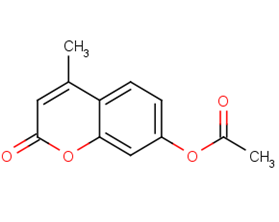
7-Acetoxy-4-methylcoumarin
CAS No. 2747-05-9
7-Acetoxy-4-methylcoumarin ( —— )
产品货号. M19337 CAS No. 2747-05-9
7-Acetoxy-4-methylcoumarin 是羧酸酯酶的荧光底物,在裂解时产生蓝色荧光溶液。
纯度: >98% (HPLC)
 COA
Datasheet
HNMR
HPLC
MSDS
Handing Instructions
COA
Datasheet
HNMR
HPLC
MSDS
Handing Instructions
| 规格 | 价格/人民币 | 库存 | 数量 |
| 200MG | ¥89 | 有现货 |


|
| 500MG | ¥120 | 有现货 |
|
| 1G | 获取报价 | 有现货 |
|
生物学信息
-
产品名称7-Acetoxy-4-methylcoumarin
-
注意事项本公司产品仅用于科研实验,不得用于人体或动物的临床与诊断
-
产品简述7-Acetoxy-4-methylcoumarin 是羧酸酯酶的荧光底物,在裂解时产生蓝色荧光溶液。
-
产品描述7-Acetoxy-4-methylcoumarin is a fluorogenic substrate for carboxylesterase yielding a blue fluorescent solution upon cleavage. The compound has been used in aprotic media, a cell membrane environmental mimic, to study superoxide and related oxyl-radical reactions of model biological membranes dispersed in aqueous media. Due to the ability for AchE to cleave and activate 7-Acetoxy-4-methylcoumarin, the fluorogenic substrate has been used to study the AchE inhibitor Tacrine·HCl (sc-200172). The compound has also been isolated from Trigonella foenum graceum.
-
体外实验——
-
体内实验——
-
同义词——
-
通路Others
-
靶点Other Targets
-
受体Others
-
研究领域——
-
适应症——
化学信息
-
CAS Number2747-05-9
-
分子量218.21
-
分子式C12H10O4
-
纯度>98% (HPLC)
-
溶解度——
-
SMILESCC(=O)Oc1ccc2c(c1)OC(=O)C=C2C
-
化学全称——
运输与储存
-
储存条件(-20℃)
-
运输条件With Ice Pack
-
稳定性≥ 2 years
参考文献
1.Berman HA,et al.Interaction of tetrahydroaminoacridine with acetylcholinesterase and butyrylcholinesterase.Mol Pharmacol. 1992 Feb;41(2):412-8.
产品手册


关联产品
-
Ipilimumab
Ipilimumab抗CTLA-4)是一种针对细胞表面抗原CTLA-4的免疫调节单克隆抗体,也是一种免疫检查点抑制剂。
-
IMS2186
IMS2186 是一种抗脉络膜新生血管 (CNV) 试剂。IMS2186 使癌细胞周期阻滞在 G2/M 期,由此发挥抗增殖和抗血管生成作用。IMS2186 无眼内毒性,并能够减少眼睛渗漏和病变细胞的数量。
-
Estredox
E2-CDS (Estradiol 17-Dihydrotrigonelline) 是一种基于氧化还原的雌二醇 (E2) 化学输送系统。E2-CDS 能够持续且大脑选择性地输送雌二醇。


