


 021-51111890
 购物车()
购物车()
 sales@molnova.cn






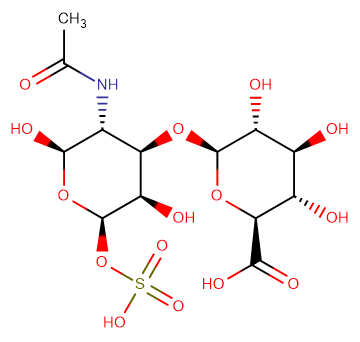
Chondroitine sulfate
CAS No. 9007-28-7
Chondroitine sulfate ( —— )
产品货号. M16476 CAS No. 9007-28-7
从鲨鱼骨中提取。
纯度: >98% (HPLC)
 COA
Datasheet
HNMR
HPLC
MSDS
Handing Instructions
COA
Datasheet
HNMR
HPLC
MSDS
Handing Instructions
| 规格 | 价格/人民币 | 库存 | 数量 |
| 100MG | ¥243 | 有现货 |


|
| 500MG | 获取报价 | 有现货 |
|
| 1G | ¥528 | 有现货 |
|
生物学信息
-
产品名称Chondroitine sulfate
-
注意事项本公司产品仅用于科研实验,不得用于人体或动物的临床与诊断
-
产品简述从鲨鱼骨中提取。
-
产品描述Extracted from shark bone;Store the product in sealed, cool and dry condition.(In Vitro):Chondroitin sulfate is a class of sulfated glycosaminoglycans that are linear polysaccharides consisting of repeating disaccharide units composed of uronic acid and N-acetylhexosamine. Several pathogens including parasites, bacteria, and viruses have been shown to utilize cell surface chondroitin sulfate chains to attach to and infect host cells. Chondroitin sulfate occurs naturally in the extracellular matrix of connective tissues, e.g., bone, cartilage, skin, ligaments and tendons. Chondroitin sulfate has been shown to elicit a range of beneficial effects: anti-inflammatory effects, an increase in type II collagen and proteoglycans, a reduction in bone resorption and a better anabolic/catabolic balance in chondrocytes. A large range of chondroitin sulfate concentrations has been used (e.g. 12.5 to 2000 mg/mL, but generally less than200 mg/mL) in in vitro studies. Chondroitin sulfate (200 mg/mL) decreases the chondrocyte susceptibility to single nucleotide polymorphism-induced apoptosis. Chondroitin sulfate reduces inflammation mediators and the apoptotic process and is able to reduce protein production of inflammatory cytokines, iNOS, MMPs. (In Vivo):The high content of chondroitin sulfate in the aggrecan plays a major part in allowing cartilage to resist tensile stresses during various loading conditions by providing this tissue with resistance and elasticity. It has been shown that chondroitin sulphate interferes with the progression of structural changes in joint tissues and is used in the management of patients with osteoarthritis. Chondroitin sulfate is mostly administered orally at doses ranging from 800 to 1200mg/day. Chondroitin sulfate is rapidly absorbed by the gastrointestinal tract. The absorbed chondroitin sulfate reaches the blood compartment as 10% chondroitin sulfate and 90% depolymerized low-molecular-weight derivatives.
-
体外实验Chondroitin sulfate is a class of sulfated glycosaminoglycans that are linear polysaccharides consisting of repeating disaccharide units composed of uronic acid and N-acetylhexosamine. Several pathogens including parasites, bacteria, and viruses have been shown to utilize cell surface chondroitin sulfate chains to attach to and infect host cells. Chondroitin sulfate occurs naturally in the extracellular matrix of connective tissues, e.g., bone, cartilage, skin, ligaments and tendons. Chondroitin sulfate has been shown to elicit a range of beneficial effects: anti-inflammatory effects, an increase in type II collagen and proteoglycans, a reduction in bone resorption and a better anabolic/catabolic balance in chondrocytes. A large range of chondroitin sulfate concentrations has been used (e.g. 12.5 to 2000 mg/mL, but generally less than200 mg/mL) in in vitro studies. Chondroitin sulfate (200 mg/mL) decreases the chondrocyte susceptibility to single nucleotide polymorphism-induced apoptosis. Chondroitin sulfate reduces inflammation mediators and the apoptotic process and is able to reduce protein production of inflammatory cytokines, iNOS, MMPs.
-
体内实验The high content of chondroitin sulfate in the aggrecan plays a major part in allowing cartilage to resist tensile stresses during various loading conditions by providing this tissue with resistance and elasticity. It has been shown that chondroitin sulphate interferes with the progression of structural changes in joint tissues and is used in the management of patients with osteoarthritis. Chondroitin sulfate is mostly administered orally at doses ranging from 800 to 1200mg/day. Chondroitin sulfate is rapidly absorbed by the gastrointestinal tract. The absorbed chondroitin sulfate reaches the blood compartment as 10% chondroitin sulfate and 90% depolymerized low-molecular-weight derivatives.
-
同义词——
-
通路Others
-
靶点Other Targets
-
受体Others
-
研究领域——
-
适应症——
化学信息
-
CAS Number9007-28-7
-
分子量463.37
-
分子式C13H21NO15S
-
纯度>98% (HPLC)
-
溶解度DMSO: 10 mM
-
SMILESCC(=O)N[C@@H]1[C@H]([C@H]([C@H](O[C@H]1O)OS(=O)(=O)O)O)O[C@H]2[C@@H]([C@H]([C@@H]([C@H](O2)C(=O)O)O)O)O
-
化学全称——
运输与储存
-
储存条件(-20℃)
-
运输条件With Ice Pack
-
稳定性≥ 2 years
参考文献
1.Kakizaki I, et al.Carbohydr Polym. 2015 May 5;121:362-7
产品手册


关联产品
-
[Sar1,Gly8]-Angioten...
[Sar1,Gly8]-Angiotensin II
-
4-O-Methylochnaflavo...
4'-O-Methylochnaflavone 是从金银花中分离得到的双黄酮类化合物,可抑制小鼠淋巴细胞增殖。
-
Biotin-Insulin Recep...
Biotin-Insulin Receptor (1142-1153), amide


