


 021-51111890
 购物车()
 sales@molnova.cn







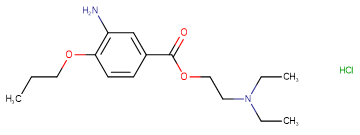
Proparacaine hydrochloride
CAS No. 5875-06-9
Proparacaine hydrochloride ( Proxymetacaine hydrochloride )
产品货号. M15166 CAS No. 5875-06-9
不可逆的局部麻醉剂;抑制疼痛感,据信可作为电压门控钠通道的拮抗剂。
纯度: >98% (HPLC)
 COA
Datasheet
HNMR
HPLC
MSDS
Handing Instructions
| 规格 | 价格/人民币 | 库存 | 数量 |
| 50MG | ¥138 | 有现货 |


|
| 500MG | 获取报价 | 有现货 |
|
| 1G | 获取报价 | 有现货 |
|
| 1 mL x 10 mM in DMSO | ¥215 | 有现货 |
|
生物学信息
-
产品名称Proparacaine hydrochloride
-
注意事项本公司产品仅用于科研实验,不得用于人体或动物的临床与诊断
-
产品简述不可逆的局部麻醉剂;抑制疼痛感,据信可作为电压门控钠通道的拮抗剂。
-
产品描述An irreversible local anesthetic; inhibits pain sensations that is believed to act as an antagonist on voltage-gated sodium channels.Pain Approved(In Vitro):Proparacaine Hydrochloride (>588.93 μM; 4-28 hours) has a dose- and time-dependent cytotoxicity to HCS cells at concentrations in vitro.Proparacaine Hydrochloride (294.47-18.85 mM; 4-12 hours) can induce apoptosis of HCS cells .Proparacaine Hydrochloride (4.71 mM; 4-12 hours) induces G1 phase arrest, plasma membrane permeability elevation, phosphatidylserine externalization, DNA fragmentation, chromatin condensation, and apoptotic body formation of HCS cells.Proparacaine Hydrochloride induces caspase-2, -3 and -9 activation, and mitochondrial transmembrane potential disruption.Proparacaine Hydrochloride (4.71 mM; 4-12 hours) downregulates and upregulates the expression of Bcl-xL and Bax, respectively, and remarkably upregulates cytoplasmic cytochrome C and apoptosis inducing factor.(In Vivo):Proparacaine Hydrochloride (75 μg/30 μL; intranasal administration; for 7 days) significantly decreases nasal symptoms, number of eosinophils, goblet cells, and mast cells in the lamina propria of the nasal mucosa.
-
体外实验Proparacaine Hydrochloride (>588.93 μM; 4-28 hours) has a dose- and time-dependent cytotoxicity to HCS cells at concentrations in vitro.Proparacaine Hydrochloride (294.47-18.85 mM; 4-12 hours) can induce apoptosis of HCS cells .Proparacaine Hydrochloride (4.71 mM; 4-12 hours) induces G1 phase arrest, plasma membrane permeability elevation, phosphatidylserine externalization, DNA fragmentation, chromatin condensation, and apoptotic body formation of HCS cells.Proparacaine Hydrochloride induces caspase-2, -3 and -9 activation, and mitochondrial transmembrane potential disruption.Proparacaine Hydrochloride (4.71 mM; 4-12 hours) downregulates and upregulates the expression of Bcl-xL and Bax, respectively, and remarkably upregulates cytoplasmic cytochrome C and apoptosis inducing factor. Cell Viability Assay Cell Line:HCS cells Concentration:294.47 μM, 588.93 μM, 1.18 mM, 2.35 mM, 4.71 mM, 9.42 mM, 18.85 mM Incubation Time:4 hours, 8 hours, and 12 hours, 16 hours, 20 hours, 24 hours, 28 hours Result:Decreased the viability of HCS cells with concentration and time at concentrations above 588.93 μM.Apoptosis Analysis Cell Line:HCS cells Concentration:294.47 μM, 588.93 μM, 1.18 mM, 2.35 mM, 4.71 mM, 9.42 mM, 18.85 mM Incubation Time:4 hours, 8 hours, and 12 hours Result:Induced apoptosis of HCS cells.Cell Cycle Analysis Cell Line:HCS cells Concentration:4.71 mM Incubation Time:4 hours, 8 hours, and 12 hours Result:Arrested HCS cells at the G1 phase of the cell cycle.Western Blot Analysis Cell Line:HCS cells Concentration:4.71 mM Incubation Time:4 hours, 8 hours, and 12 hours Result:Down-regulated the expression level of anti-apoptotic protein Bcl-xL and up-regulated the pro-apoptotic protein Bax, whereas significantly up-regulated the cytoplasmic amounts of mitochondria-released cytochrome C and apoptosis-inducing factor (AIF).
-
体内实验Proparacaine Hydrochloride (75 μg/30 μL; intranasal administration; for 7 days) significantly decreases nasal symptoms, number of eosinophils, goblet cells, and mast cells in the lamina propria of the nasal mucosa. Animal Model:7-week-old female BALB/c mice, allergic rhinitis model Dosage:75 μg/30 μL Administration:Intranasal administration, for 7 days Result:Significantly reduced nasal rubbing and sneezing.
-
同义词Proxymetacaine hydrochloride
-
通路Membrane Transporter/Ion Channel
-
靶点Sodium Channel
-
受体Voltage-gatedsodiumchannel
-
研究领域Neurological Disease
-
适应症Pain
化学信息
-
CAS Number5875-06-9
-
分子量330.8502
-
分子式C16H27ClN2O3
-
纯度>98% (HPLC)
-
溶解度10 mM in DMSO
-
SMILESCCCOC1=C(C=C(C=C1)C(=O)OCCN(CC)CC)N.Cl
-
化学全称Benzoic acid, 3-amino-4-propoxy-, 2-(diethylamino)ethyl ester, hydrochloride (1:1)
运输与储存
-
储存条件(-20℃)
-
运输条件With Ice Pack
-
稳定性≥ 2 years
参考文献
1. Gusovsky F, et al. Brain Res. 1990 Jun 4;518(1-2):101-6.
2. McAlvin JB, et al. Invest Ophthalmol Vis Sci. 2015 Jun;56(6):3820-6.
3. Hung CH, et al. Anesth Analg. 2010 Jan 1;110(1):238-42.
产品手册


关联产品
-
Tetrodotoxin
Tetrodotoxin (TTx) 是一种有效的、高选择性的钠通道阻滞剂,对于 Nav1.6 的 IC50 为 33 nM。
-
VGSCs-IN-1
VGSCs-IN-1 (compound 14) 是 Riluzole (HY-B0211) 的 2-哌嗪类似物,是一种人电压门控钠通道 (VGSC) 抑制剂。VGSCs-IN-1 显示出良好的 Nav1.4 阻断活性。VGSCs-IN-1 的 pKa 为 7.6,cLog P 为 2.4。VGSCs-IN-1可用于细胞兴奋性障碍研究。
-
APETx2
Acid-sensing ion channel 3 (ASIC3) channel blocker (IC50 values are 63 and 175 nM for homomeric rat and human ASIC3 channels). Also inhibits NaV1.8 and NaV1.2 channels (IC50 values are 55 and 114 nM respectively). Demonstrates analgesic properties against acid-induced and inflammatory pain.


