


 021-51111890
 购物车()
购物车()
 sales@molnova.cn







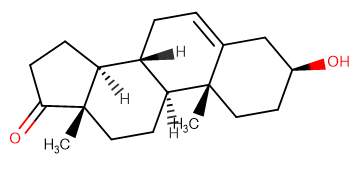
Dehydroepiandrosterone
CAS No. 53-43-0
Dehydroepiandrosterone ( Androstenolone | trans-Dehydroandrosterone | DHEA | Diandrone | NSC 9896 | Prasterone | Psicosterone )
产品货号. M14899 CAS No. 53-43-0
DHEA(脱氢异雄酮)是一种重要的内源性类固醇激素。
纯度: >98% (HPLC)
 COA
Datasheet
HNMR
HPLC
MSDS
Handing Instructions
COA
Datasheet
HNMR
HPLC
MSDS
Handing Instructions
| 规格 | 价格/人民币 | 库存 | 数量 |
| 25MG | ¥172 | 有现货 |


|
| 50MG | ¥258 | 有现货 |
|
| 100MG | ¥374 | 有现货 |
|
| 500MG | ¥1195 | 有现货 |
|
| 1G | 获取报价 | 有现货 |
|
生物学信息
-
产品名称Dehydroepiandrosterone
-
注意事项本公司产品仅用于科研实验,不得用于人体或动物的临床与诊断
-
产品简述DHEA(脱氢异雄酮)是一种重要的内源性类固醇激素。
-
产品描述DHEA (Dehydroisoandrosterone) is an important endogenous steroid hormone; DHEA also has a variety of potential biological effects in its own right, binding to an array of nuclear and cell surface receptors and acting as a neurosteroid.(In Vitro):DHEA (Prasterone) is an effective antiapoptotic factor, reversing the serum deprivation-induced apoptosis in prostate cancer cells (DU145 and LNCaP cell lines) as well as in colon cancer cells (Caco2 cell line). DHEA (Prasterone) significantly reduces serum deprivation-induced apoptosis in all 3 cancer cell types, quantitated with the APOPercentage assay (apoptosis is reduced from 0.587±0.053 to 0.142±0.0016 or 0.059±0.002 after treatment for 12 hours with DHEA or NGF, respectively; n=3, P<0.01), and by flow cytometry analysis (FACS) for DU145 cells. The antiapoptotic effect of DHEA is dose dependent with an EC50 at nanomolar concentrations (EC50: 11.2±3.6 nM and 12.4±2.2 nM in DU145 and Caco2 cells, respectively). DHEA (Prasterone) is the principal sex steroid precursor in humans and can be converted directly to androgens. DHEA (Prasterone) (≥1 μM) causes a dose-dependent inhibition of Chub-S7 proliferation, as assessed by thymidine incorporation assays. DHEA (Prasterone) treatment inhibits expression of the key glucocorticoid-regulating genes H6PDH (≥100 nM) and HSD11B1 (≥1 μM) in differentiating preadipocytes in a dose-dependent manner. In keeping with this finding, DHEA (Prasterone) treatment (≥1 μM) results in a marked reduction in 11β-HSD1 oxoreductase activity (≥1 μM) and a concurrent increase in dehydrogenase activity at the highest DHEA dose used (25 μM DHEA) in differentiated adipocytes. (In Vivo):DHEA (Prasterone) in the diet (0.45 % w/w) of male B6 mice (groups of five mice) treated for 8 weeks led to significant decreases in body temperature compared with mice fed the control AIN-76A diet. A similar comparison indicated that control and pair-fed mice are also significantly different. Animals fed DHEA (Prasterone) have significantly lower temperatures than mice fed the control diet 26/29 times tested; mice pair fed to those on the DHEA (Prasterone) diet are less affected, with 8/29 values significantly lower than in mice fed AIN-76A ad libitum. The temperatures of mice fed DHEA (Prasterone) or pair fed to DHEA (Prasterone) are significantly different 21/29 times tested. Body weights are significantly greater in mice fed the control diet than in mice fed DHEA or pair fed to DHEA (Prasterone). Food intake (grams per day) from cages are averaged for each week (n=7), except for Week 9 (n=3). The amount of food intake is significantly decreased in mice fed DHEA (Prasterone). By design, mice pair fed to DHEA (Prasterone) ate about the same amount. Thus, it appears that DHEA (Prasterone) reduces body temperature by food restriction and by a separate mechanism.
-
体外实验DHEA (Prasterone) is an effective antiapoptotic factor, reversing the serum deprivation-induced apoptosis in prostate cancer cells (DU145 and LNCaP cell lines) as well as in colon cancer cells (Caco2 cell line). DHEA (Prasterone) significantly reduces serum deprivation-induced apoptosis in all 3 cancer cell types, quantitated with the APOPercentage assay (apoptosis is reduced from 0.587±0.053 to 0.142±0.0016 or 0.059±0.002 after treatment for 12 hours with DHEA or NGF, respectively; n=3, P<0.01), and by flow cytometry analysis (FACS) for DU145 cells. The antiapoptotic effect of DHEA is dose dependent with an EC50 at nanomolar concentrations (EC50: 11.2±3.6 nM and 12.4±2.2 nM in DU145 and Caco2 cells, respectively). DHEA (Prasterone) is the principal sex steroid precursor in humans and can be converted directly to androgens. DHEA (Prasterone) (≥1 μM) causes a dose-dependent inhibition of Chub-S7 proliferation, as assessed by thymidine incorporation assays. DHEA (Prasterone) treatment inhibits expression of the key glucocorticoid-regulating genes H6PDH (≥100 nM) and HSD11B1 (≥1 μM) in differentiating preadipocytes in a dose-dependent manner. In keeping with this finding, DHEA (Prasterone) treatment (≥1 μM) results in a marked reduction in 11β-HSD1 oxoreductase activity (≥1 μM) and a concurrent increase in dehydrogenase activity at the highest DHEA dose used (25 μM DHEA) in differentiated adipocytes.
-
体内实验DHEA (Prasterone) in the diet (0.45 % w/w) of male B6 mice (groups of five mice) treated for 8 weeks led to significant decreases in body temperature compared with mice fed the control AIN-76A diet. A similar comparison indicated that control and pair-fed mice are also significantly different. Animals fed DHEA (Prasterone) have significantly lower temperatures than mice fed the control diet 26/29 times tested; mice pair fed to those on the DHEA (Prasterone) diet are less affected, with 8/29 values significantly lower than in mice fed AIN-76A ad libitum. The temperatures of mice fed DHEA (Prasterone) or pair fed to DHEA (Prasterone) are significantly different 21/29 times tested. Body weights are significantly greater in mice fed the control diet than in mice fed DHEA or pair fed to DHEA (Prasterone). Food intake (grams per day) from cages are averaged for each week (n=7), except for Week 9 (n=3). The amount of food intake is significantly decreased in mice fed DHEA (Prasterone). By design, mice pair fed to DHEA (Prasterone) ate about the same amount. Thus, it appears that DHEA (Prasterone) reduces body temperature by food restriction and by a separate mechanism.
-
同义词Androstenolone | trans-Dehydroandrosterone | DHEA | Diandrone | NSC 9896 | Prasterone | Psicosterone
-
通路Endocrinology/Hormones
-
靶点Androgen Receptor (AR)
-
受体Androgen Receptor
-
研究领域Endocrinology
-
适应症——
化学信息
-
CAS Number53-43-0
-
分子量288.42
-
分子式C19H28O2
-
纯度>98% (HPLC)
-
溶解度Ethanol: 57 mg/mL (197.62 mM); DMSO: 57 mg/mL (197.62 mM)
-
SMILESC[C@]1([C@](CC2)([H])[C@]3([H])CC=C4C[C@@H](O)CC[C@]4(C)[C@@]3([H])CC1)C2=O
-
化学全称(3S,8R,9S,10R,13S,14S)-3-hydroxy-10,13-dimethyl-1,2,3,4,7,8,9,10,11,12,13,14,15,16-tetradecahydro-17H-cyclopenta[a]phenanthren-17-one
运输与储存
-
储存条件(-20℃)
-
运输条件With Ice Pack
-
稳定性≥ 2 years
参考文献
1.Chen F, et al. Endocrinology. 2005 Nov; 146(11):4568-76.
产品手册


关联产品
-
BMS-641988
BMS-641988 是一种有效的、选择性的非甾体雄激素受体拮抗剂,Ki 为 1.7 nM,MDA-MB-453 细胞 IC50 为 16 nM。
-
VPC-13566
VPC-13566是一种BF3特异性小分子,可有效抑制雄激素受体转录活性并从BF3口袋中置换BAG1L肽。
-
Triclocarban
三氯卡班是一种抗菌剂,用于个人清洁产品。


