


 021-51111890
 购物车()
购物车()
 sales@molnova.cn







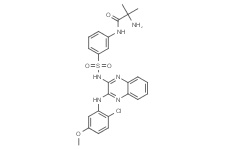
Pilaralisib
CAS No. 934526-89-3
Pilaralisib ( XL147 | XL 147 | SAR245408 | SAR 245408 | Pilaralisib )
产品货号. M17672 CAS No. 934526-89-3
Pilaralisib 是一种口服小分子,可选择性抑制磷酸肌醇 3 激酶 (PI3K) 的活性。
纯度: >98% (HPLC)
 COA
Datasheet
HNMR
HPLC
MSDS
Handing Instructions
COA
Datasheet
HNMR
HPLC
MSDS
Handing Instructions
| 规格 | 价格/人民币 | 库存 | 数量 |
| 2MG | ¥365 | 有现货 |


|
| 5MG | ¥510 | 有现货 |
|
| 10MG | ¥948 | 有现货 |
|
| 25MG | ¥1596 | 有现货 |
|
| 50MG | ¥2406 | 有现货 |
|
| 100MG | ¥3362 | 有现货 |
|
| 200MG | 获取报价 | 有现货 |
|
| 500MG | 获取报价 | 有现货 |
|
| 1G | 获取报价 | 有现货 |
|
生物学信息
-
产品名称Pilaralisib
-
注意事项本公司产品仅用于科研实验,不得用于人体或动物的临床与诊断
-
产品简述Pilaralisib 是一种口服小分子,可选择性抑制磷酸肌醇 3 激酶 (PI3K) 的活性。
-
产品描述Pilaralisib, also known as XL147, is a Class 1 PI3K kinase family inhibitor, and is a n orally bioavailable small molecule, targeting the class I phosphatidylinositol 3 kinase (PI3K) family of lipid kinases, with potential antineoplastic activity. Class 1 PI3K kinase family inhibitor XL147 reversibly binds to class 1 PI3Ks in an ATP-competitive manner, inhibiting the production of the secondary messenger phosphatidylinositol-3,4,5-trisphosphate (PIP3) and activation of the PI3K signaling pathway; this may result in inhibition of tumor cell growth and survival in susceptible tumor cell populations. Activation of the PI3K signaling pathway is frequently associated with tumorigenesis.(In Vitro):Pilaralisib (XL147) displays potent inhibitory activity against Class I PI3K isoforms p110α, p110δ, and p110γ, with IC50s of 39, 36, and 23 nM, respectively. Pilaralisib (XL147) is less potent against the remaining Class I isoform, p110β, with an IC50 value of 383 nM. The IC50 value for inhibition of PI3Kα by Pilaralisib (XL147) is determined at various concentrations of ATP, revealing XL147 to be an ATP-competitive inhibitor with an equilibrium inhibition constant (Ki) value of 42 nM. Pilaralisib (XL147) has relatively weak inhibitory activity toward the class III PI3K vacuolar sorting protein 34 (VPS34; IC50 value of ~7.0 M) and the PI3K-related DNA-dependent protein kinase (DNA-PK; IC50 value of 4.75 μM). In an mTOR kinase immunoprecipitation assay using cell lysates, Pilaralisib (XL147) does not inhibit mTOR activity toward the physiologic substrate protein eukaryotic translation initiation factor 4E-binding protein 1 (4EBP1; IC50>15 μM). Consistent with its inhibitory activity against purified PI3K proteins, Pilaralisib (XL147) inhibits EGF-induced PIP3 production in PC-3 and MCF7 cells in serum-free medium with IC50s of 220 and 347 nM, respectively. The ability of Pilaralisib (XL147) to inhibit phosphorylation of key signaling proteins downstream of PI3K is examined by assessing its effects on EGF-stimulated phosphorylation of AKT and on nonstimulated phosphorylation of S6 in PC-3 cells in serum-free media by cell-based ELISA. Pilaralisib (XL147) inhibits these activities with IC50s of 477 and 776 nM, respectively. (In Vivo):The ability of Pilaralisib (XL147) to inhibit this endogenous phosphorylation of AKT, p70S6K, and S6 is examined following a single oral dose of 10, 30, 100, or 300 mg/kg. The tumors are harvested 4, 24, or 48 hours postdose and homogenized in lysis buffer. Tumor lysates from each animal (n=4) are then pooled for each group and analyzed for levels of total and phosphorylated AKT, p70S6K, and S6 by Western immunoblotting. Administration of Pilaralisib (XL147) causes a dose-dependent decrease in phosphorylation of AKT, p70S6K, and S6 in the tumors, reaching a maximum of 81% inhibition of AKT phosphorylation at 300 mg/kg at 4 hours. The dose-response relationships derived from the 4-hour time point predict 50% inhibition of AKT, p70S6K, and S6 phosphorylation at doses of approximately 100 mg/kg (pAKTT308), 54 mg/kg (pAKTS473), 71 mg/kg (p-p70S6K), and 103 mg/kg (pS6). The inhibition of AKT, p70S6K, and S6 phosphorylation in MCF7 tumors following a 100 mg/kg dose of Pilaralisib (XL147) is maximal at 4 hours, reaching 55% to 75%; however, the level of inhibition decreased to 8% to 45% by 24 hours, and only minimal or no inhibition was evident by 48 hours. Following a 300 mg/kg dose of Pilaralisib (XL147), inhibition is also maximal at 4 hours (65%-81%). However, in contrast with the 100 mg/kg dose, inhibition at 24 hours (51%-78%) is almost comparable with that seen at 4 hours, and partial inhibition (25%-51%) persisted through 48 hours.
-
体外实验Pilaralisib (XL147) displays potent inhibitory activity against Class I PI3K isoforms p110α, p110δ, and p110γ, with IC50s of 39, 36, and 23 nM, respectively. Pilaralisib (XL147) is less potent against the remaining Class I isoform, p110β, with an IC50 value of 383 nM. The IC50 value for inhibition of PI3Kα by Pilaralisib (XL147) is determined at various concentrations of ATP, revealing XL147 to be an ATP-competitive inhibitor with an equilibrium inhibition constant (Ki) value of 42 nM. Pilaralisib (XL147) has relatively weak inhibitory activity toward the class III PI3K vacuolar sorting protein 34 (VPS34; IC50 value of ~7.0 M) and the PI3K-related DNA-dependent protein kinase (DNA-PK; IC50 value of 4.75 μM). In an mTOR kinase immunoprecipitation assay using cell lysates, Pilaralisib (XL147) does not inhibit mTOR activity toward the physiologic substrate protein eukaryotic translation initiation factor 4E-binding protein 1 (4EBP1; IC50>15 μM). Consistent with its inhibitory activity against purified PI3K proteins, Pilaralisib (XL147) inhibits EGF-induced PIP3 production in PC-3 and MCF7 cells in serum-free medium with IC50s of 220 and 347 nM, respectively. The ability of Pilaralisib (XL147) to inhibit phosphorylation of key signaling proteins downstream of PI3K is examined by assessing its effects on EGF-stimulated phosphorylation of AKT and on nonstimulated phosphorylation of S6 in PC-3 cells in serum-free media by cell-based ELISA. Pilaralisib (XL147) inhibits these activities with IC50s of 477 and 776 nM, respectively.
-
体内实验The ability of Pilaralisib (XL147) to inhibit this endogenous phosphorylation of AKT, p70S6K, and S6 is examined following a single oral dose of 10, 30, 100, or 300 mg/kg. The tumors are harvested 4, 24, or 48 hours postdose and homogenized in lysis buffer. Tumor lysates from each animal (n=4) are then pooled for each group and analyzed for levels of total and phosphorylated AKT, p70S6K, and S6 by Western immunoblotting. Administration of Pilaralisib (XL147) causes a dose-dependent decrease in phosphorylation of AKT, p70S6K, and S6 in the tumors, reaching a maximum of 81% inhibition of AKT phosphorylation at 300 mg/kg at 4 hours. The dose-response relationships derived from the 4-hour time point predict 50% inhibition of AKT, p70S6K, and S6 phosphorylation at doses of approximately 100 mg/kg (pAKTT308), 54 mg/kg (pAKTS473), 71 mg/kg (p-p70S6K), and 103 mg/kg (pS6). The inhibition of AKT, p70S6K, and S6 phosphorylation in MCF7 tumors following a 100 mg/kg dose of Pilaralisib (XL147) is maximal at 4 hours, reaching 55% to 75%; however, the level of inhibition decreased to 8% to 45% by 24 hours, and only minimal or no inhibition was evident by 48 hours. Following a 300 mg/kg dose of Pilaralisib (XL147), inhibition is also maximal at 4 hours (65%-81%). However, in contrast with the 100 mg/kg dose, inhibition at 24 hours (51%-78%) is almost comparable with that seen at 4 hours, and partial inhibition (25%-51%) persisted through 48 hours.
-
同义词XL147 | XL 147 | SAR245408 | SAR 245408 | Pilaralisib
-
通路Cell Cycle/DNA Damage
-
靶点Aurora Kinase
-
受体PI3Kα| PI3Kβ| PI3Kγ| PI3Kδ
-
研究领域Cancer
-
适应症——
化学信息
-
CAS Number934526-89-3
-
分子量541.02
-
分子式C25H25ClN6O4S
-
纯度>98% (HPLC)
-
溶解度DMSO : 6 mg/mL. 11.09 mM;
-
SMILESC(=O)(C(C)(C)N)Nc1cc(ccc1)S(=O)(=O)Nc1nc2c(nc1Nc1c(ccc(c1)OC)Cl)cccc2
-
化学全称2-amino-N-(3-(N-(3-((2-chloro-5-methoxyphenyl)amino)quinoxalin-2-yl)sulfamoyl)phenyl)-2-methylpropanamide.
运输与储存
-
储存条件(-20℃)
-
运输条件With Ice Pack
-
稳定性≥ 2 years
参考文献
1. Foster P, et al. Mol Y Ther. 2015, 14(4), 931-940.